

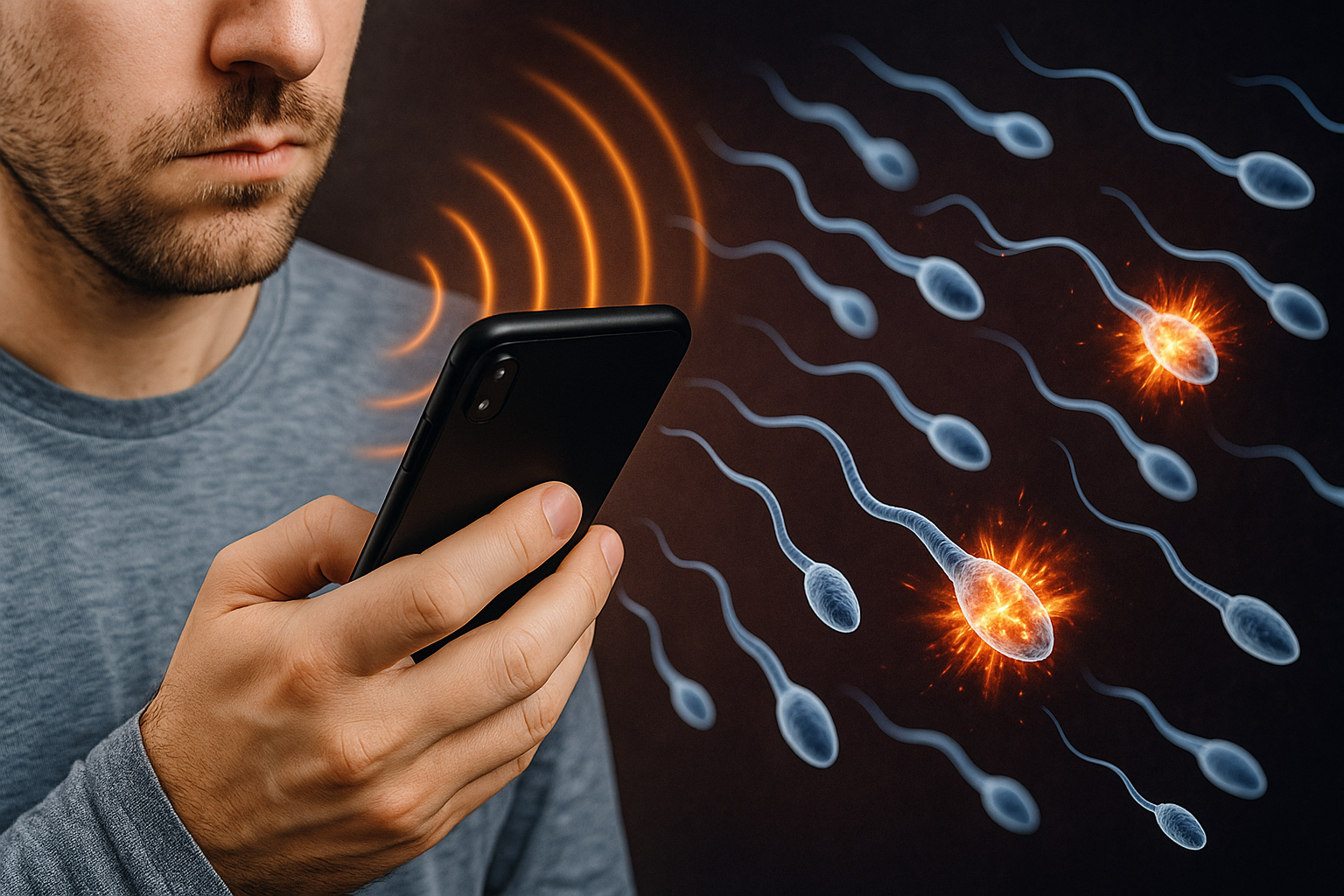
Over the past decade, the discussion of male infertility has increasingly been linked to the issue of everyday habits. One of them is the prolonged use of mobile phones, which has become a completely normal part of life today.
Fertilization is a complex process dependent on healthy spermatogenesis and hormonal balance. Numerous environmental and behavioral factors (pesticides, stress, diet) have long been studied, and increasing attention is also being paid to radiofrequency electromagnetic fields (RF-EMF) emitted by mobile phones.
How electromagnetic radiation affects sperm
The testicles are probably the most sensitive organ to the effects of radiation. The most vulnerable are the immature germ cells from which sperm are produced. Even relatively low exposure to ionizing radiation, less than 1 Gy (a unit of absorbed radiation dose), can cause oligospermia, i.e. a reduced sperm count. At doses above 3 Gy, azoospermia occurs: a complete absence of sperm. Although mobile phones emit non-ionizing radiation, prolonged and repeated exposure triggers oxidative stress in the testicles, which can damage cell membranes, mitochondria and DNA.
The analysis showed that frequent use of mobile phones reduces sperm motility. Men who frequently carry their phones in their pockets were about 8% more likely to have reduced motility. In addition, the research also showed a decrease in sperm concentration and an increased rate of abnormal shapes.
Oxidative stress, DNA damage and hormonal changes
Laboratory experiments have shown that electromagnetic radiation affects enzymes that are crucial for providing sperm with energy. In exposed cases, a decrease in the activity of the enzyme creatine kinase was measured, which means a weaker ability of sperm to produce energy for movement. In addition, a decrease in the activity of histone kinase and a decrease in testosterone levels were detected after exposure to microwaves. DNA fragmentation (the breakdown of genetic material) increased, which can lead to infertility or the risk of genetic defects in offspring.
Also of interest are the observations about Leydig cells, which produce testosterone. These cells are more resistant than germ cells, but at very high doses of radiation, above 20 Gy, they can be damaged and result in hypogonadism (a condition in which the body produces too little testosterone). Although mobile phones do not cause such high doses, long-term use can disrupt hormonal balance indirectly through oxidative stress.
Open questions and future research
The analyses show that the results of individual studies are not entirely uniform. In some, the effects on sperm motility and morphology are pronounced, in others less so. However, the overall conclusion is clear: frequent and long-term use of mobile phones is associated with lower sperm quality. However, open questions remain: a large part of the data is based on animal experiments or on exposure to higher doses in patients receiving radiotherapy. The transfer of these results to daily use of mobile phones is not straightforward, but the mechanisms, such as oxidative stress, DNA damage and changes in enzyme activity, are consistent with the changes observed in humans.
Further long-term studies are needed to closely monitor the timing and pattern of phone use and correlate this data with changes in sperm quality. It also raises the question of protective measures, such as the use of materials that reduce RF-EMF exposure, or behavioral changes, such as avoiding carrying the phone in a trouser pocket.
In short
Mobile phones have become a daily companion, but at the same time they can affect male fertility. The most common problems are problems with sperm motility, which is reduced by about 8 percent on average. A decrease in their concentration and poorer morphology have also been observed. Experiments have found changes in enzymes that give sperm energy, as well as fluctuations in testosterone levels.
Although phones emit weaker radiation than medical radiotherapy, prolonged use and proximity to the testicles pose risks.
Exercise and male fertility: how much is just right?
The psychological impact of infertility on men